
Selecting the central mixing unit for your batch plant is a critical decision with long-lasting implications for your productivity, product quality, and operational costs. The choice between a vertical mixer and a twin-shaft mixer for your concrete batch plant for sale is often presented as a simple matter of scale, but this is a reductive view. In truth, it represents a fundamental selection between two distinct philosophies of agitation and material handling. Each system possesses a unique set of capabilities and limitations, making it exceptionally well-suited for specific applications while being less optimal for others. A careful, analytical approach to this decision is essential to ensure your investment aligns perfectly with your current projects and future growth trajectory, preventing costly mismatches between your equipment and your ambitions.
Core Principles: Deconstructing the Mixing Action
To understand which mixer is right for your operation, we must first examine the core mechanical principles that define their function. A vertical mixer, also known as a pan mixer, operates on a principle of turbulent cascade mixing. A single vertical shaft, equipped with stars or blades, rotates within a stationary pan. The action is primarily one of lifting and dropping the materials, relying on gravity to create a folding and intermingling motion. This method is highly effective for a wide range of standard concrete mixes and is characterized by its mechanical simplicity.

In contrast, a twin-shaft mixer employs a more aggressive, mechanical approach. Two horizontal shafts, each fitted with overlapping mixing arms, rotate in opposite directions. This creates a highly intensive shearing and kneading action. The materials are not merely folded but are forcibly pushed, squeezed, and spread between the intermeshing arms. This results in a powerful scrubbing action that is particularly adept at coating each aggregate particle with cement paste. The mixing energy is imparted directly by the machinery, making it less reliant on gravity alone. This fundamental difference in agitation methodology—cascading versus shearing—is the primary determinant of their respective performance profiles.
Performance and Output: Matching the Mixer to Your Production Reality
The divergence in mixing principles leads directly to tangible differences in performance on the portable concrete batch plant floor. When analyzing batch cycle time, twin-shaft mixers generally hold a significant advantage. Their intense, mechanical action achieves a homogeneous mix much faster than a vertical mixer of comparable volume. This reduced cycle time directly translates to a higher potential throughput for your plant, a critical factor for high-volume production environments like pre-cast factories or large infrastructure projects.
The quality of mix homogeneity is another key differentiator. While vertical mixers produce excellent quality for standard ready-mix concrete, twin-shaft mixers excel with specialized and challenging mix designs. Their kneading action is superior for mixing stiff, zero-slump concretes, fiber-reinforced concretes, and mixes with high volumes of supplementary cementitious materials. The <strong>shearing action ensures a uniform dispersion</strong> of fibers and a complete coating of all particles, mitigating the risk of balling or segregation. From an operational standpoint, vertical mixers often have fewer wear parts and can be simpler to maintain, whereas twin-shaft mixers, with their more complex gearbox and dual-shaft system, may have higher maintenance demands but offer unparalleled mixing intensity and speed.
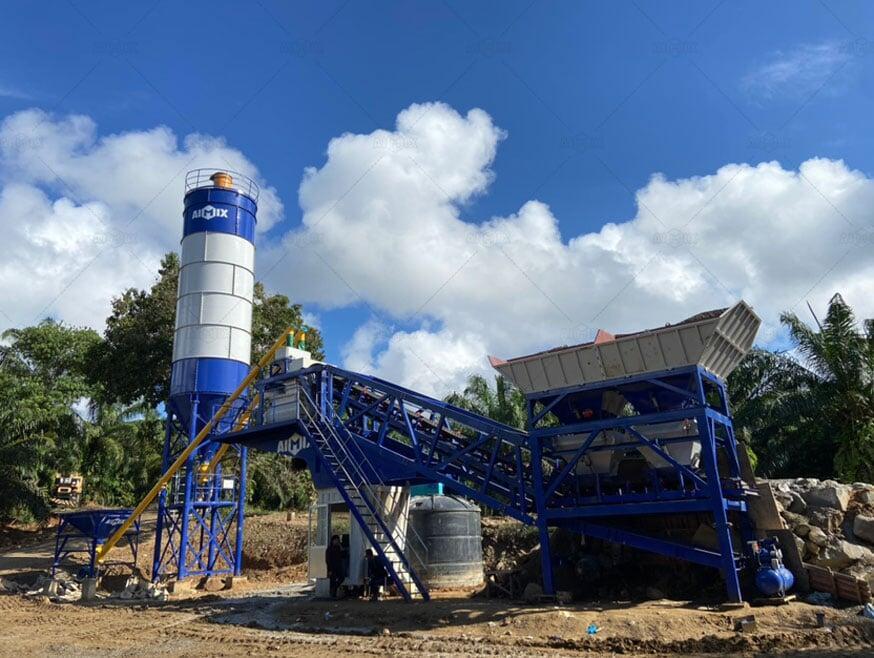
Making the Strategic Choice: A Framework for Decision-Making
The final selection should not be based on a single metric but on a holistic analysis of your specific needs. Begin by prioritizing your project requirements. If your business revolves around high-volume production of standard ready-mix concrete with a focus on operational simplicity and lower initial investment, a vertical mixer is likely the most prudent and effective choice. Its performance is more than adequate for this domain.
However, if your work consistently involves specialized mixes, requires the fastest possible cycle times to maximize output, or deals with complex recipes where perfect homogeneity is non-negotiable, the twin-shaft mixer presents a compelling case. The analysis must then extend to the total cost of ownership. While the capital expenditure for a twin-shaft mixer is higher, its increased production capacity and superior performance on premium mixes can generate a faster return on investment. The final verdict hinges on aligning the mixer's technological strengths with your core business objectives. By carefully weighing mixing action, performance needs, and financial implications, you can confidently select the mixer that is the right fit, ensuring your small concrete batch plant for sale operates at its peak potential for years to come.