The construction landscape of Nepal presents a unique confluence of challenges that render conventional concrete placement methods surprisingly inefficient. Narrow urban streets in Kathmandu, steep topography in hill stations like Pokhara, and the logistical nightmare of transporting ready-mix trucks across a country where infrastructure is still catching up to development all conspire against the contractor who relies solely on traditional approaches. It is within this context that the mini concrete pump has emerged not merely as a convenience but as a financial instrument capable of reshaping project economics. For the Nepali contractor—whether engaged in a residential tower in Lalitpur or a commercial development in Bharatpur—the decision to invest in or rent a mini concrete pump involves a calculus that extends far beyond the machine's purchase price. The true return on investment materializes through a constellation of savings: reduced labor wages, elimination of material waste, accelerated project timelines, and the ability to access sites that would otherwise require costly manual handling or complex crane operations. Understanding these interconnected financial levers is essential for any contractor seeking to maintain margins in an increasingly competitive market where labor costs are rising and project deadlines are unforgiving.
Labor Optimization and the Reduction of Manual Handling Costs
The most immediate and tangible ROI from a mini
concrete pump in Nepal derives from labor restructuring. Traditional concrete placement in the Nepali context often relies upon a human chain—a line of laborers passing buckets or pans of concrete from the mixer location to the pour point. For a typical three-story residential structure in a Kathmandu suburb, this manual process might consume twelve to fifteen laborers across a pour day, with wages now ranging from NPR 800 to 1,200 per worker. A mini pump, operated by a crew of just three to four individuals—one managing the remote control, one guiding the hose, and one assisting with mixer coordination—reduces the labor requirement by 60 to 70 percent. The savings compound across multiple pours. Over a twelve-month period encompassing fifteen to twenty major pours, the labor cost differential alone can reach NPR 300,000 to 500,000. Moreover, the elimination of manual handling reduces the incidence of workplace injuries—a hidden cost that contractors often underestimate. When a laborer suffers a back injury from carrying heavy buckets, the ripple effects include medical expenses, compensation claims, and the disruption of project continuity. The mini pump effectively substitutes mechanical consistency for physical exertion, converting what was once a high-risk, labor-intensive operation into a controlled, low-stress process.
Material Efficiency and the Elimination of Waste
Beyond labor, the second pillar of ROI resides in material conservation—an area where Nepali contractors frequently hemorrhage profit without realizing it. Manual concrete placement inherently generates waste. Spillage during bucket transfers, concrete left adhering to mixing platforms, and the inability to precisely control the pour volume all contribute to over-ordering. A common practice in manual operations involves ordering an additional 10 to 15 percent of concrete to account for anticipated waste and spillage. A
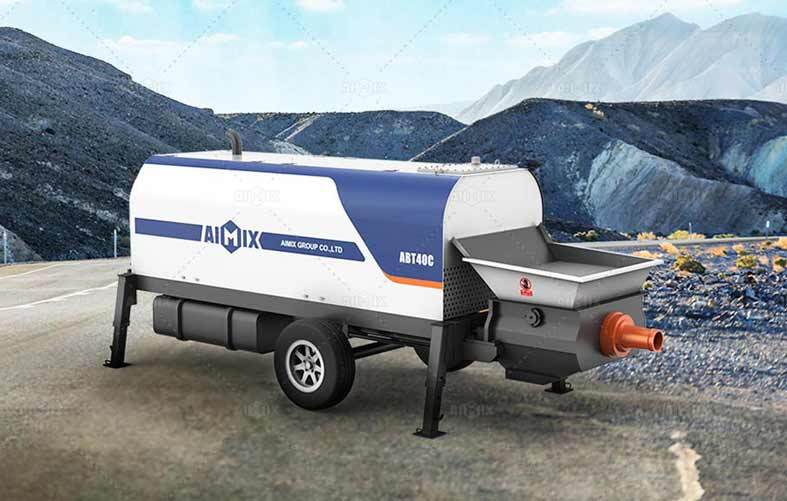
small concrete pump for sale, with its articulated hose and remote-controlled nozzle, delivers concrete exactly where it is needed, with minimal loss. The operator can pause flow instantaneously when a column form is filled, resuming only when the next section is prepared. This precision translates directly into cement savings—a critical consideration given that cement constitutes the most expensive component of the concrete mix. For a contractor completing four to six medium-scale projects annually, the cumulative savings on cement and aggregates can approach NPR 400,000 to 700,000 per year. Additionally, the pump reduces the need for over-ordering from ready-mix suppliers, allowing contractors to order precisely calculated volumes with confidence. In an industry where material costs represent 50 to 60 percent of total project expenditure, this waste reduction exerts a meaningful influence on final profitability.
Accelerated Timelines and Access to Challenging Sites
The third dimension of ROI operates at the level of project velocity and site accessibility—factors that determine not only direct costs but also the contractor's ability to secure future work. Pouring concrete with a mini pump proceeds at a rate that manual methods cannot approach. A typical column pour that might consume an entire day with a labor chain can be completed in two to three hours with a pump. This acceleration compresses construction schedules, allowing contractors to complete projects faster and free their crews for subsequent work. In a market where capital is tied up in ongoing projects, faster completion means improved cash flow and the ability to take on more contracts annually. Furthermore, the mini pump's ability to navigate narrow access ways and pump vertically to heights of twenty meters or more unlocks sites that would otherwise be economically unviable. Consider a hillside plot in a place like Dharan or a congested urban infill site in Birgunj. Without a pump, the contractor might face exorbitant costs for a concrete boom truck—equipment that is scarce in Nepal and commands premium rental rates—or accept the inefficiencies of manual bucket brigades. The mini pump bridges this gap, offering a middle path that combines affordability with capability. When contractors factor in the intangible but very real value of securing projects that competitors cannot efficiently execute, the ROI narrative expands beyond simple cost savings to encompass market differentiation and revenue growth.