The South African infrastructure landscape is marked by a peculiar contradiction. On one hand, the country possesses a sophisticated construction industry capable of executing megaprojects of considerable complexity. On the other, vast stretches of the Eastern Cape, Limpopo, and the Northern Cape remain underserved by the very infrastructure that would enable their development—roads, bridges, rural clinics, and water schemes. The obstacle is not ambition but logistics. Traditional concrete delivery relies upon a centralized model: a stationary batching plant, a fleet of transit mixers, and a network of paved roads capable of supporting heavy vehicle movements. When a project site lies beyond this network—in a remote village, a mountainous region, or a newly designated mining concession—the costs escalate exponentially, and the feasibility of conventional construction collapses. The self loading concrete mixer for sale has emerged as a solution uniquely suited to these conditions. It consolidates the functions of a loader, a mixer, and a transporter into a single chassis capable of navigating terrain that would defeat a ready-mix truck. For contractors working in South Africa’s remote regions, the self-loading mixer is not merely an equipment choice; it is the enabling technology that transforms logistically impossible projects into commercially viable undertakings.
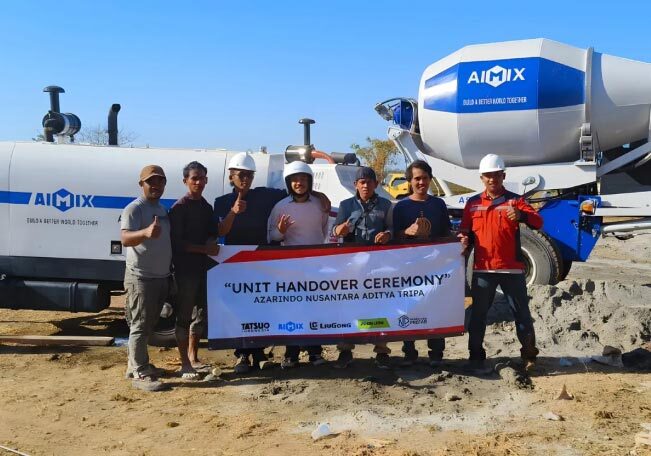
The Geography of Logistical Failure: Why Remote Sites Break Conventional Supply Chains
The failure of conventional concrete supply in remote South African locations is not a matter of inefficiency; it is a structural incompatibility. A typical ready-mix truck requires paved roads, turning circles adequate for its articulated chassis, and a journey time from plant to pour that does not exceed ninety minutes. In rural areas, none of these conditions reliably hold. Roads that appear passable on a survey map may become impassable after seasonal rains. Bridges designed for light vehicles may not bear the weight of a fully loaded transit mixer. The result is a construction paradox: the very infrastructure required to deliver concrete cannot be built because the concrete cannot be delivered. Self-loading mixers resolve this paradox by relocating the point of production. They travel empty, requiring only a track width sufficient for their passage. Upon arrival at the site, they source aggregates from local deposits or from stockpiles delivered by smaller vehicles that can navigate the access constraints. Water is drawn from boreholes, rivers, or municipal supplies. The concrete is produced on-site, poured, and the machine departs. The supply chain is collapsed into a single machine, eliminating the dependency on centralized plants and the trucking fleets that serve them.
Economic Recalibration: Shifting Costs from Transport to Production
The economic logic of remote-site construction shifts fundamentally when self-loading mixers replace conventional delivery. In the traditional model, transport costs dominate the project budget. A ready-mix truck traveling two hundred kilometers from a plant to a remote site may consume more in fuel, driver wages, and tire wear than the concrete it carries is worth. The cost per cubic meter escalates with distance, rendering small-scale projects economically unviable.
Self loading mixer for sale in South Africa invert this cost structure. Transport cost is minimized because the machine travels empty; the economic focus shifts to production efficiency. A single operator can produce fifteen to twenty cubic meters of concrete per day, a volume sufficient for the foundation of a rural clinic, the slab of a school, or the culverts for a farm-to-market road. The cost per cubic meter remains stable regardless of the site’s remoteness, bounded only by the local availability of aggregates and water. For contractors bidding on rural infrastructure tenders, this economic recalibration opens opportunities previously foreclosed. A project that would have required a dedicated batching plant and a fleet of trucks can now be executed with a single self-loading mixer, a small support vehicle, and a crew of local laborers.
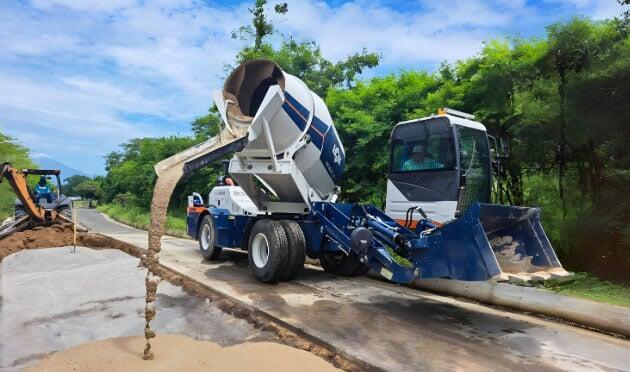
Operational Autonomy: Managing Variability in Remote Environments
Remote construction sites introduce variables that urban projects never encounter. Aggregate quality may vary between borrow pits. Water sources may be seasonal. Power supply may be nonexistent, requiring all equipment to operate on diesel. The self-loading
mini cement mixer’s operational autonomy makes it exceptionally suited to this variability. The machine’s onboard weighing system allows the operator to adjust mix designs in real time, compensating for variations in aggregate moisture content or particle size distribution. Its diesel engine requires no external power, and its hydraulic systems are designed for the dust and temperature extremes typical of South Africa’s rural interiors. Furthermore, the machine’s mobility enables a project sequencing strategy unavailable to conventional methods. A contractor working on a rural road rehabilitation can move the mixer along the alignment as work progresses, producing concrete at each culvert location precisely when the earthworks are ready. This just-in-time production eliminates the laydown areas, stockpiles, and double-handling that characterize conventional rural construction, reducing the project’s physical footprint and minimizing the environmental disturbance associated with infrastructure development.
Sectoral Applications: From Municipal Infrastructure to Private Development
The application of self-loading mixers across South Africa’s remote regions spans public and private sectors, each with distinct operational demands. In municipal infrastructure, the machines are increasingly deployed for the construction of water reservoirs, pump station foundations, and rural sanitation facilities. Local municipalities, operating under constrained budgets, find that self-loading mixers enable them to execute multiple small projects across a district with a single capital investment, rather than commissioning separate contractors for each site. In the private sector, the agricultural industry has become a significant adopter. Farmers in the Free State and Mpumalanga use self-loading mixers to construct feedlots, irrigation reservoirs, and livestock handling facilities on properties where a ready-mix truck would struggle to maneuver. The mining sector, too, has recognized the value. Exploration camps, temporary processing facilities, and remote accommodation units all require concrete foundations in locations far from established supply chains. For each of these sectors, the self-loading mixer delivers a common benefit: the ability to execute concrete construction in locations where the conventional supply chain simply cannot reach, transforming remote site logistics from a barrier to entry into a manageable operational variable.