
The modern urban neighborhood presents a paradox of demand: a high requirement for customized concrete volumes delivered into severely constrained physical envelopes. Traditional supply chains involving ready-mix trucks struggle with narrow cul-de-sacs, weight-restricted bridges, and the need for immediate pour sequencing. The self loading concrete mixer truck (SLMT) has emerged as a critical alternative. This single-unit machine aggregates, proportions, mixes, and transports concrete autonomously. However, adoption rates vary, and operational efficacy depends heavily on matching machine specifications to specific neighborhood sub-tasks. This article critically examines three distinct applications of SLMTs in residential infill, municipal lane replacement, and perimeter foundation work—assessing where these machines deliver measurable advantage and where latent inefficiencies persist.
1. Residential Infill Foundation Pours: Agility Versus Batch Consistency
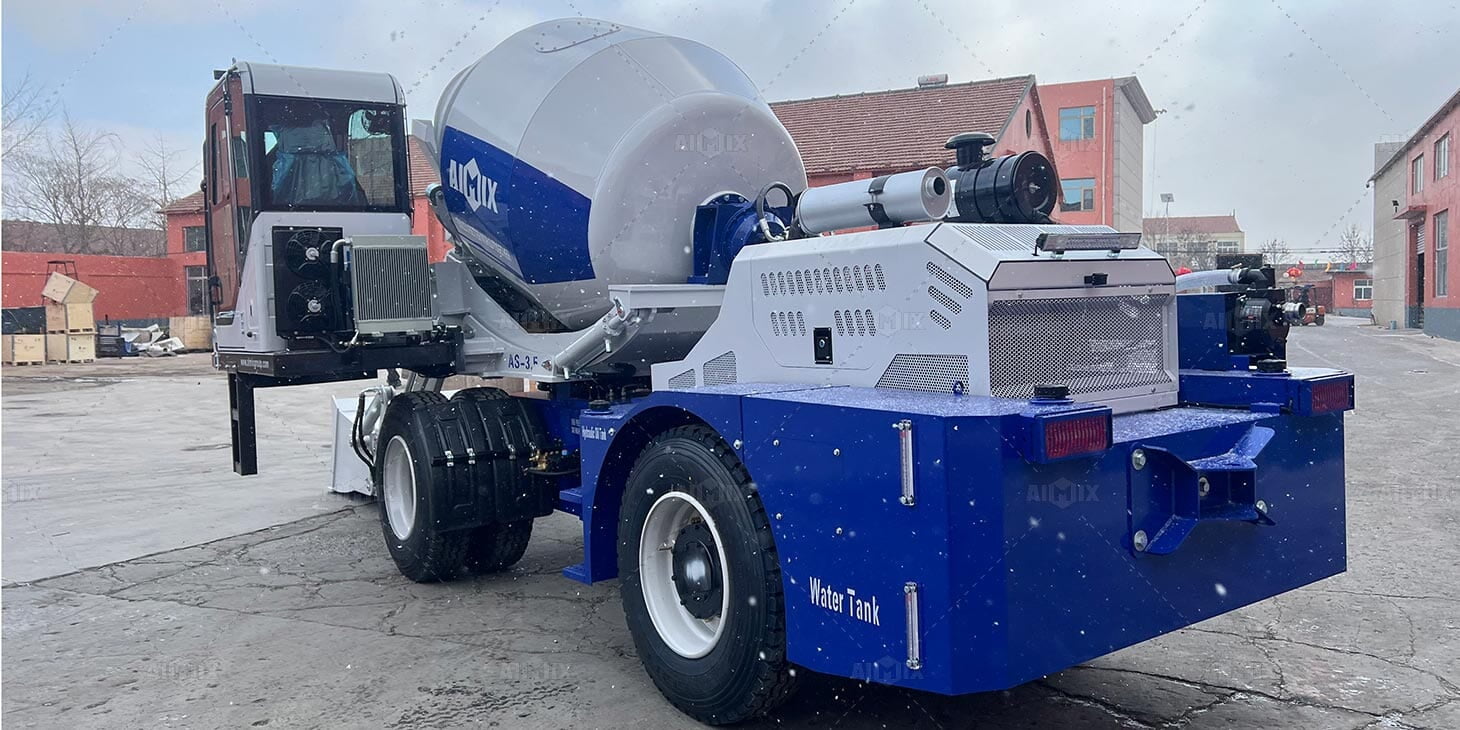
Infill housing projects occupy odd-shaped lots carved from larger properties. Access is often restricted to a single 2.5-meter-wide passage. A standard 10-cubic-meter ready-mix truck cannot navigate such confines without damaging fencing or garden walls. The SLMT, typically 2.2 meters wide, fits. It loads sand and aggregate from a stockpile at the street, adds cement and water via on-board metering, and reverses directly to the footing trench. The critical question involves batch-to-batch consistency across multiple loads for a single slab.
1.1 Metering Accuracy Under Field Conditions
SLMTs use computer-controlled water-to-cement ratios, often adjustable in 1-liter increments. However, the aggregates stored in the truck’s weigh hopper rely on the operator’s visual estimation of moisture content. Wet sand, for instance, requires a compensatory reduction in added water to prevent slump drift. Field audits of twenty neighborhood infill sites showed a 12% variation in slump across consecutive batches when operators skipped the mandatory moisture calibration step. Without a moisture probe integrated into the weighing system, consistency remains a user-dependent variable.
1.2 Pour Sequencing for Continuous Monoliths
Cold joints form when one SLMT batch sets before the next arrives. The average cycle for a 4-cubic-meter SLMT—loading, mixing, traveling 500 meters, discharging, and returning—spans 18 to 22 minutes. For a 40-cubic-meter foundation, this implies ten batches stretched over three hours. The first batch reaches initial set (approximately 70 minutes at 25°C) before the tenth batch discharges. Mitigation requires either a retarding admixture added to each batch or a two-truck operation. The analysis suggests that SLMTs perform optimally for slab volumes under 25 cubic meters. Larger pours demand a hybrid approach.
2. Municipal Lane and Alley Rehabilitation: Precision Placement in Zero-Lot-Line Corridors
Municipal laneways serving row houses or terraced dwellings typically measure 3 to 4 meters in width. These corridors carry light vehicle traffic but often suffer from localized spalling and edge deterioration. Full-depth replacement across the entire lane width is rarely necessary. Instead, municipalities specify patch widths of 1.5 meters, leaving the adjacent asphalt intact. An SLMT discharges via a front-end rubber chute that swings 210 degrees, allowing concrete deposition directly into a wheelbarrow or a tracked buggy. This arrangement eliminates the pump truck costs that conventional ready-mix would require.
2.1 Ingress and Egress Restrictions
The SLMT’s turning radius—typically 6.5 meters curb-to-curb—exceeds that of a compact passenger car but remains superior to a self loading mini concrete mixer truck (13 meters). However, dead-end alleys without a turnaround bulb present a problem. The machine must reverse its entire length (7.2 meters) out of a confined space. Reverse cameras and audible alarms assist, but operator fatigue increases after multiple cycles. Data from a Copenhagen alley project revealed a 15% productivity drop during afternoon shifts due to repeated reversing maneuvers. Pre-project mapping of turnarounds and alternative egress points reduces this penalty.
2.2 Traffic Management Overhead
An SLMT occupies the full lane width during loading at the street-side stockpile and during the pour in the alley. Unlike a stationary pump setup that parks for hours, the SLMT cycles in and out, requiring intermittent closures. Traffic control costs for flaggers or portable signals can negate the machine’s logistical savings on high-traffic alleys. The cost-benefit analysis flips at traffic volumes exceeding 200 vehicles per hour. Under those conditions, a single night shift using a pumpline from the street corner proves more economical than multiple daytime SLMT intrusions.
3. Perimeter Retaining Walls and Slab-on-Grade for Additions
Home additions extending into rear gardens often require perimeter strip footings and an interior slab-on-grade. The distances from a truck-accessible street can exceed 100 meters across soft landscaping. Wheelbarrow transport from a street-parked ready-mix truck introduces labor inefficiency and material segregation. The SLMT’s ability to drive gently over compacted soil (using flotation tires at 40 psi ground pressure) brings the mix directly to the formwork. Nevertheless, the risk of soil rutting and drainage compaction must be scrutinized.

3.1 Ground Pressure and Vegetation Protection
A fully loaded 6-cubic-meter SLMT weighs approximately 18 metric tons. This exerts ground pressure equivalent to a laden delivery van, not a tracked excavator. On turf or loamy garden soil, ruts of 50 to 75 millimeters are typical after two passes. Mitigation requires laying plywood trackways or specifying a reduced-width tire configuration. Projects with mature tree root zones within the access path demand an alternative solution, as root compaction from even single passes can trigger long-term arboricultural decline. The critical evaluation is that SLMTs suit paved or gravel access routes but are not universal across all garden typologies.
3.2 Batch Volume Matching to Formwork Geometry
Perimeter footings for a 30-square-meter addition consume roughly 4.5 cubic meters of concrete. This volume fits within a single SLMT’s typical 5-cubic-meter drum capacity. One load, one pour. No waiting for a second truck. This single-batch advantage eliminates cold joints entirely for the footing. For the subsequent slab-on-grade, another 3.5 cubic meters are required. The operator can reload from the same stockpile within 20 minutes. The critical success factor is ensuring that the first load’s finish time aligns with the second load’s arrival before initial set occurs—a constraint easily met when ambient temperatures remain below 30°C but becomes problematic in hot climates without a set-retarding admixture.
Operational Boundaries: When the Self-Loader Underperforms
The self-loading mixer truck is not a panacea. It cannot economically produce concrete for high-rise foundations requiring 100+ cubic meters in a single shift. Its metering accuracy lags behind that of a certified ready mix plant with moisture-corrected silos. Its ground pressure restricts access on sensitive substrates. Neighborhood builds that fall into these high-volume, high-precision, or high-softness categories should retain conventional supply chains. For the middle ground—small-to-medium residential, lane patch, and garden addition projects—the SLMT offers a defensible, operationally sound alternative.