
Drainage construction is a recurring requirement at many mining operations in South Africa. Open-pit mines, underground mining facilities, haul roads, processing areas, and tailings infrastructure all require concrete drainage channels, culverts, collection pits, retaining structures, and water management facilities. These works are rarely completed in one operation. As mining activities expand and site layouts change, contractors may need to construct new drainage sections, repair existing channels, or extend water diversion systems across different working areas. For contractors handling repeated drainage projects, the cost of concrete supply can become a significant part of project expenditure. Transporting ready-mixed concrete from an external supplier may be impractical when work zones are remote or scattered across a large mining site. A self-loading concrete mixer offers an alternative by combining aggregate loading, weighing, mixing, and transportation in one machine. Whether purchasing one is worthwhile depends on the frequency of concrete work, daily production requirements, site accessibility, labor availability, and the total cost of operating the equipment over multiple projects.
Why Drainage Projects Create Recurring Concrete Demand at Mines
Concrete Works Extend Beyond Initial Mine Development
Mining drainage systems require continuous construction and maintenance. Surface channels divert stormwater away from excavation areas and haul roads, while culverts allow water to pass beneath access routes. Collection pits, sedimentation structures, and concrete-lined drains help manage water around processing facilities and operational buildings. These structures may need to be extended as mining areas develop. Heavy vehicle traffic, ground movement, erosion, and seasonal rainfall can also damage existing drainage infrastructure. Contractors therefore face recurring concrete demand rather than a single, isolated construction requirement. For projects spread across large mining properties, a **self loading concrete mixer in South Africa** can provide an on-site production option without requiring every concrete delivery to originate from a central commercial batching facility.
How a Self-Loading Concrete Mixer Supports Remote Mining Work
One Machine Handles Several Concrete Production Tasks
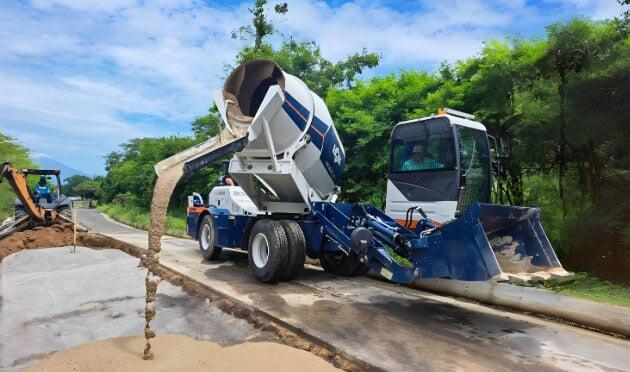
A self-loading concrete mixer integrates aggregate loading, material weighing, water addition, mixing, and concrete transportation. Its front loading bucket collects sand and aggregates, while the weighing system helps control the material proportions before mixing. This arrangement reduces the need to coordinate a separate loader, batching equipment, and transit mixer for smaller or dispersed concrete operations. The operator can prepare concrete near the drainage work area and move the fresh mix to the placement location.

Mobility Helps Serve Scattered Work Zones
Mining drainage projects are not always concentrated in one location. A contractor may need to construct a channel beside a haul road, repair a culvert near an excavation area, and pour a collection pit close to a processing facility. A self-loading mixer can travel between suitable work zones, reducing dependence on fixed concrete production locations. Its practical mobility depends on road gradients, ground bearing capacity, machine dimensions, and site traffic conditions. Steep, muddy, or unstable routes still require careful access planning.
When Buying Is More Practical Than Hiring or Outsourcing Concrete
Repeated Projects Improve Equipment Utilization
Purchasing becomes more attractive when a contractor has a consistent pipeline of drainage work across one mine or several mining sites. Instead of arranging external concrete deliveries for every small pour, the contractor can schedule production around daily construction activities. For example, a drainage contractor may undertake several short channel sections over consecutive weeks, followed by culvert bases and concrete collection pits. Although each individual pour may be relatively small, their combined concrete demand can justify owning a mixer. By contrast, hiring may be more economical when drainage work is occasional, short-term, or limited to a few isolated pours.
Compare the Full Cost of Concrete Supply
The decision should account for more than the purchase quotation. Contractors need to compare equipment ownership costs with external concrete prices, delivery charges, waiting time, and the cost of arranging multiple machines. The actual **concrete mixer price in South Africa** should be assessed alongside transport, import-related expenses where applicable, operator wages, fuel, maintenance, insurance, and spare parts. A purchase may offer better long-term value when equipment utilization remains sufficiently high.
Choosing the Right Mixer Capacity for Mining Drainage Work
Match Production Capacity with Daily Pouring Requirements
Drainage construction generally involves repeated concrete placement rather than continuous high-volume pouring. Contractors should estimate the daily volume required for channel sections, culvert structures, foundations, and collection pits before selecting a machine. | Drainage application | Main equipment consideration | |---|---| | Small drainage channels | Compact capacity and maneuverability | | Culvert bases and headwalls | Consistent batch output and material control | | Large collection pits | Higher output and sufficient mixing capacity | | Extended drainage networks | Production rate and travel distance | A larger machine is not automatically more productive. If the placement team cannot handle its output, concrete may wait too long before discharge. Conversely, an undersized unit may struggle to keep up with several active work fronts.
Consider a Large Mixer for Higher Concrete Demand
For contractors managing extensive drainage networks or several simultaneous work zones, a **large concrete mixer machine** may be worth considering. Higher-capacity models can reduce the number of batches required for larger pours, provided that site access, aggregate supply, and placement arrangements can support the increased output. The selection should also consider drum capacity, effective discharge volume, engine power, drive configuration, and gradeability. These specifications influence how the equipment performs under demanding mining-site conditions.
Operating Considerations at South African Mining Sites
Account for Ground Conditions and Site Access
Mining roads can include steep gradients, loose aggregate, uneven surfaces, and muddy sections during rainy periods. Contractors should assess the machine's drive configuration, ground clearance, tires, and climbing capability against actual site conditions. The mixer should also have sufficient space to load aggregates, turn safely, and discharge concrete without interfering with haul trucks or other mining equipment.
Maintain Reliable Material and Equipment Supply
On-site production does not eliminate the need for organized material logistics. Sand, aggregates, cement, and water must be available in suitable quantities and protected from contamination. Aggregate moisture should be monitored because it affects the actual water content of the concrete mix. Routine inspection of the engine, hydraulic system, loading bucket, weighing equipment, and mixing drum is equally important. Contractors should confirm local access to technical support and replacement parts before purchasing.
How to Evaluate the Long-Term Investment
Calculate Utilization Across Multiple Projects
A practical investment assessment should consider the expected working days per month, average concrete volume per day, number of projects served, and equipment downtime. Contractors should compare these figures with the annual cost of ownership and the expense of purchasing concrete externally. The calculation should include: - Initial equipment purchase and transportation costs - Fuel, lubricants, and routine maintenance - Operator wages and training - Spare parts and unexpected repairs - Insurance, storage, and equipment depreciation
Buy When Recurring Demand Justifies Ownership
A self loading concrete mixer for sale is worth buying when drainage work is frequent, concrete demand is sufficiently predictable, and projects are distributed across locations where external supply is difficult or expensive to coordinate. Its integrated production process can simplify smaller concrete operations and reduce reliance on several separate machines. For contractors handling occasional drainage repairs, equipment rental or ready-mixed concrete may remain the more economical choice. The decision should ultimately reflect the total workload, site conditions, and expected equipment utilization.
Conclusion
Repeated drainage projects at South African mines can create a strong case for owning a self-loading concrete mixer, particularly when contractors need to produce concrete across remote or dispersed work areas. Its loading, mixing, and transportation functions provide operational flexibility for channels, culverts, collection pits, and related infrastructure. However, the investment is justified only when recurring concrete demand can support the purchase and operating costs. By comparing project frequency, required output, mining-site accessibility, and long-term equipment utilization, contractors can determine whether ownership offers a more practical solution than hiring or outsourcing concrete supply.